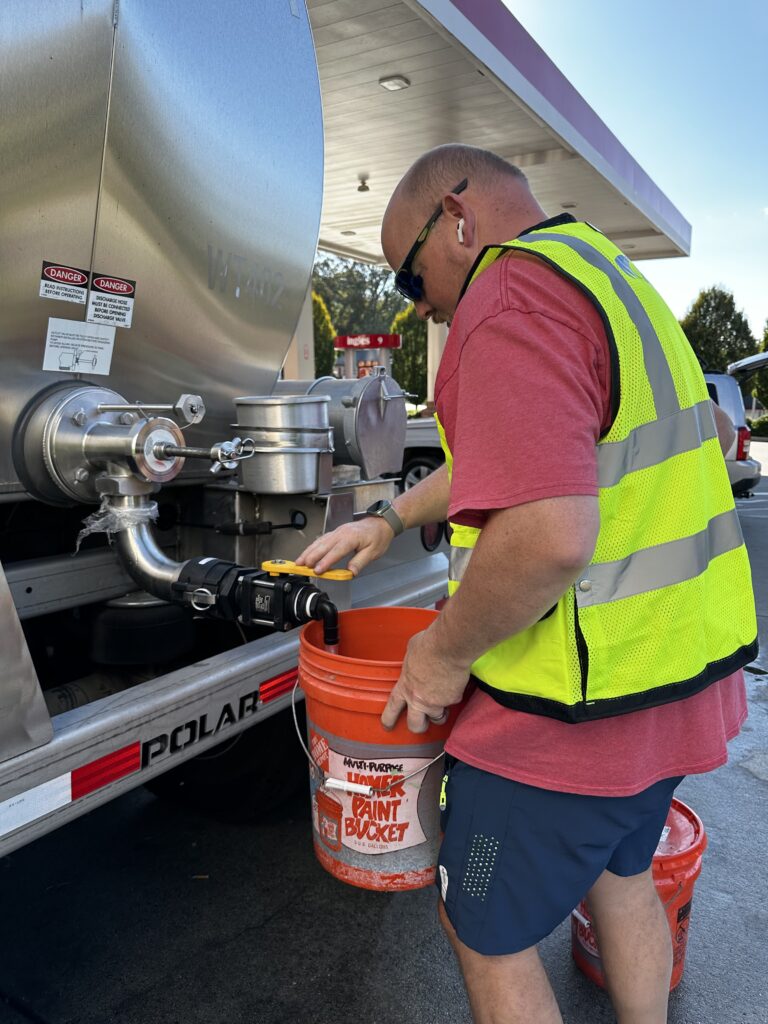
Run out of diesel and your operation stops. Run out of DEF and it stops just as hard – most operators simply haven’t planned for it.
Specialty Fuel Services has been delivering bulk fuel and diesel exhaust fluid since 2006, to fleets, hospitals, data centers and utilities across the country – including into places where the normal supply chain has already broken down.
Let’s Talk! · Call us at 1-866-445-5508
When Your Fleet Runs Out of DEF, It Stops
Virtually every diesel engine built since 2010 has an emissions system that depends on diesel exhaust fluid. It isn’t optional, and it isn’t something a driver can work around.
When the DEF tank runs low, the engine warns. When it runs empty, the engine derates – power is cut, and the vehicle is typically limited to around 5 mph. Many units won’t restart at all until DEF has been added.
That behavior is written into the engine’s emissions software to meet federal requirements. It isn’t a fault, so a mechanic can’t clear it, and there is no workaround in the field. The only fix is DEF, on site.
Which means an empty DEF tank strands a vehicle exactly as completely as an empty fuel tank. The difference is that everybody plans for fuel.
What Is Bulk DEF Delivery?
Diesel exhaust fluid is roughly one third urea and two thirds purified water. It’s clear, non-flammable and non-hazardous. It never enters the engine – it’s injected into the exhaust stream, where it converts nitrogen oxides into harmless nitrogen and water vapor before they reach the tailpipe.
DEF has its own tank, usually under a blue cap, kept entirely separate from the fuel system. The two are never mixed.
Small operations buy DEF in jugs. Once you’re running a fleet or a yard full of equipment that burns it daily, jugs stop making sense:
- Handling cost. Somebody has to order, carry, pour and dispose of every container.
- Contamination risk. DEF is sensitive to dirt and to residue in an unclean container, and off-spec fluid can damage the emissions system it’s meant to protect.
- Running out. Jug stock is invisible until the moment it isn’t there.
Bulk delivery means DEF arrives in a tote, or straight into a tank on your site, in a quantity matched to what you actually use.
How Much DEF Does Your Operation Use?
As a rule of thumb, DEF consumption runs at about 2 to 3% of the diesel you burn. Every 100 gallons of diesel needs roughly 2 to 3 gallons of DEF.
That’s easy to ignore day to day, and easy to get badly wrong when demand spikes. A fleet running extended hours through a response operation burns fuel at a rate nobody sees in normal weeks – and the DEF requirement scales with it.
A fleet getting through 1,000 gallons of diesel a day will use somewhere between 20 and 30 gallons of DEF a day. Across a five-day operation that’s 100 to 150 gallons: more than a single drum, and more than most yards keep on the shelf.
If you don’t know your consumption, tell us your diesel volumes and we’ll size the DEF for you.
Delivery Options and Quantities
We supply DEF in the format that suits how you work, from a pallet of jugs to a tanker filling your bulk tank directly.
- Jugs – by the case or the pallet, for light or intermittent use
- Drums – for yards and workshops with steady, moderate demand
- Totes – the standard choice for fleets, with pump options for dispensing on site
- Direct bulk fill – straight into your tank, for the highest-volume operations
Deliveries can be set up on a fixed schedule, called off as you need them, or dispatched as an emergency run.
DEF for Emergency and Disaster Response
Most suppliers can get a tote to you next week. That isn’t the problem we exist to solve.
Specialty Fuel Services maintains strategic fuel reserves in north-central Mississippi and runs a nationwide delivery fleet built for the days when normal distribution has stopped – after a hurricane, through a winter storm, or during a regional shortage. It’s the work we’ve done since 2006, for hospitals, data centers, utilities and government agencies.
DEF is worth planning for separately from diesel, because it can become scarce on its own. It’s made from urea, and the urea market is global and volatile: export restrictions in 2021 and 2022 triggered DEF shortages and sharp price rises in several countries. Having diesel on site is no guarantee of having DEF.
If you’re building a business continuity plan, DEF belongs in it. We’ll help you work out what to hold, and we’ll deliver it when you need it.
Who We Deliver DEF To
If your operation can’t afford to stop, we’ve probably fueled one like it.
- Data centers
- Hospitals and healthcare facilities
- Power and utility companies
- Federal, state and municipal agencies
- Police and fire departments
- Grocery and retail distribution
- Construction and heavy equipment fleets
- Commercial and municipal vehicle fleets
We deliver nationwide, from Houston to Miami and everywhere our customers operate.
Why Specialty Fuel Services
- Since 2006. Nearly two decades moving bulk fuel in conditions where moving it is hard.
- Nationwide. Strategic reserves and a national fleet, not a regional delivery route.
- 24/7. Emergencies don’t schedule themselves, so neither do we.
- One supplier. DEF alongside gasoline, diesel, propane, Jet A and AvGas – and potable water when it comes to that.
Frequently Asked Questions
What is bulk DEF?
Bulk DEF means diesel exhaust fluid delivered into a tote or a fixed tank on your site, rather than in sealed jugs or drums. It typically starts around the 275-gallon mark. Operations move to bulk when the handling cost and contamination risk of containers outweigh the convenience.
How much DEF does a truck use?
Roughly 2 to 3% of the diesel it burns – about 2 to 3 gallons of DEF per 100 gallons of fuel. A truck getting through 50 gallons of diesel a day will use somewhere between 1 and 1.5 gallons of DEF. Heavier loads and harder duty cycles push the figure up.
What happens if you run out of DEF?
The engine derates. Power is cut and the vehicle is typically limited to around 5 mph, and many units will not restart until DEF is added. It’s mandated in the engine’s emissions software rather than being a fault, so it can’t be cleared or overridden in the field.
Does DEF freeze?
Yes, at about 12°F. That’s expected and harmless – DEF thaws without losing quality, and vehicle systems are designed to thaw it themselves. Freezing is not a reason to avoid holding DEF through winter, though bulk storage should be planned with it in mind.
How long does DEF last, and does it go bad?
Stored correctly, DEF keeps for a year or more. Heat and direct sunlight shorten that considerably, so stock held for emergency use should be stored cool and out of the light, and rotated rather than left indefinitely.
Is DEF flammable?
No. DEF is non-flammable and classed as non-hazardous, which makes it far simpler to store and transport than fuel. It should still be kept clean and sealed, as contamination is the main risk to the emissions system it protects.
Can you deliver DEF and diesel together?
Yes – we can deliver both at the same time, on the same run.
How quickly can you deliver in an emergency?
The same way we deliver fuel. Our dispatchers are on call 24/7, and as soon as we’ve spoken we start building a delivery plan around your location, your volumes and the conditions on the ground. We run a nationwide fleet from strategic reserves, so wherever you are, we’re set up to get DEF to you as quickly as the situation allows. Customers with a plan already in place with us are first in line when an event hits.
Not Sure Where To Start?
Tell us what you run, where you run it and roughly how much diesel you get through. We’ll work out the DEF, and put a delivery plan behind it – scheduled, on call, or standing by for the next event. Call us at 1-866-445-5508.
RELATED POSTS
-
Upcoming Storms Near Me: Preparedness and Response
Upcoming Storms Near Me: Preparedness and Response In recent weeks, the United States has experienced a series of powerful storms, affecting various regions from the … Read more
-
Water Supply in Emergency Situations: A Lifesaving Resource in Times of Crisis
Water Supply in Emergency Situations: A Lifesaving Resource in Times of Crisis When disasters like Hurricane Helene strike, there’s one resource that becomes absolutely vital … Read more
-
Car Emergency Kit List
Car emergencies aren’t fun, and they’re nearly everyone’s nightmare. Whether you’re on the side of the road waiting for help or facing a lengthy delay, … Read more